AFFECTING BEHAVIOUR IN YOUNG MALE DRIVERS THROUGH MASS MEDIA CAMPAIGNS
In 2014, South Australia had a higher road toll than in preceding years. At the time of the project, the state’s road toll was projected to be higher again in 2015. The project aim was to explore methods of affecting the driving behaviour of young male drivers aged 16-25 to address this demographic as the most prevalent in road accidents in South Australia. The project used on-campus mass media deployment combined with alternative approach media strategies to connect with the intended audience and explore different communication strategies. The target audience for the project was young male drivers, aged 18-24 with a secondary target audience of young female drivers.
PROJECT AIMS
The primary aim was to promote message recall & understanding amongst young male drivers. The secondary aim was to prompt young male drivers to adopt safer driving strategies and/or reduce common unsafe habits while driving a vehicle. Thirdly, the project aimed to explore methods of concept creation using a group dynamic. A secondary objective of the project was to also test whether claims that campaigns aimed at Young Male Drivers tended to affect female drivers instead was worthy of further study.
METHODOLOGY
The project utilised three public health messaging strategies as vehicles to promote action on three distinct issues on South Australian roads. The strategies used were Roger’s Protection Motivation Theory, Extended Parallel Process Model, and Bandura’s Social Learning Theory. The issues promoted were Wet Weather Driving, Speeding, and Distracted Driving.
A series of media designs were drawn up over the course of the first semester and were displayed on-campus during the month of September using a mixture of techniques. A sample of the student and teacher cohort were surveyed once the posters had been removed. The surveys assessed the efficacy of the media messaging and media deployment as well as the participants’ personal experiences with road safety.
CAMPAIGN DESIGN
The creative research project’s campaigns were designed through a group concept process, before being adapted and refined into the final designs by myself and Pippa Lawrie, the project’s Art Director. The final designs are included in the attached appendix. The theory and techniques used are described below for each campaign’s designs. Each campaign used a traditional poster design paired with an experiential alternative design to test different methods of imparting messaging.
WET WEATHER
The campaign designs were based on the Extended Parallel Process Model (EPPM), which was developed from Roger’s Protection Motivation Theory. The EPPM is uses four factors that function together to create three possible outcomes. There is only one positive outcome that allows the individual to manage the threat, which was the purpose of the design.
The campaign used A4 posters in partnership with an alternative design of a 1m X 0.5m graphic vinyl sticker installed on the ground at the pedestrian entrance to the University car parks.


SPEEDING
The Speeding posters were designed around Roger’s Protection Motivation Theory (RPMT).
RPMT relies on an individual’s perception of a threat; their perception of the likelihood the threat will occur; their perception of the seriousness of the threat; and how likely they believe the suggested behaviour will avert the threat and whether they are capable of performing the suggested behaviour.
The campaign used A4 posters in partnership with an alternative design. The design was printed on paper lunch bags that were used by an on-campus university café for takeaway food. One thousand bags were printed & provided to the café during the course of the project.


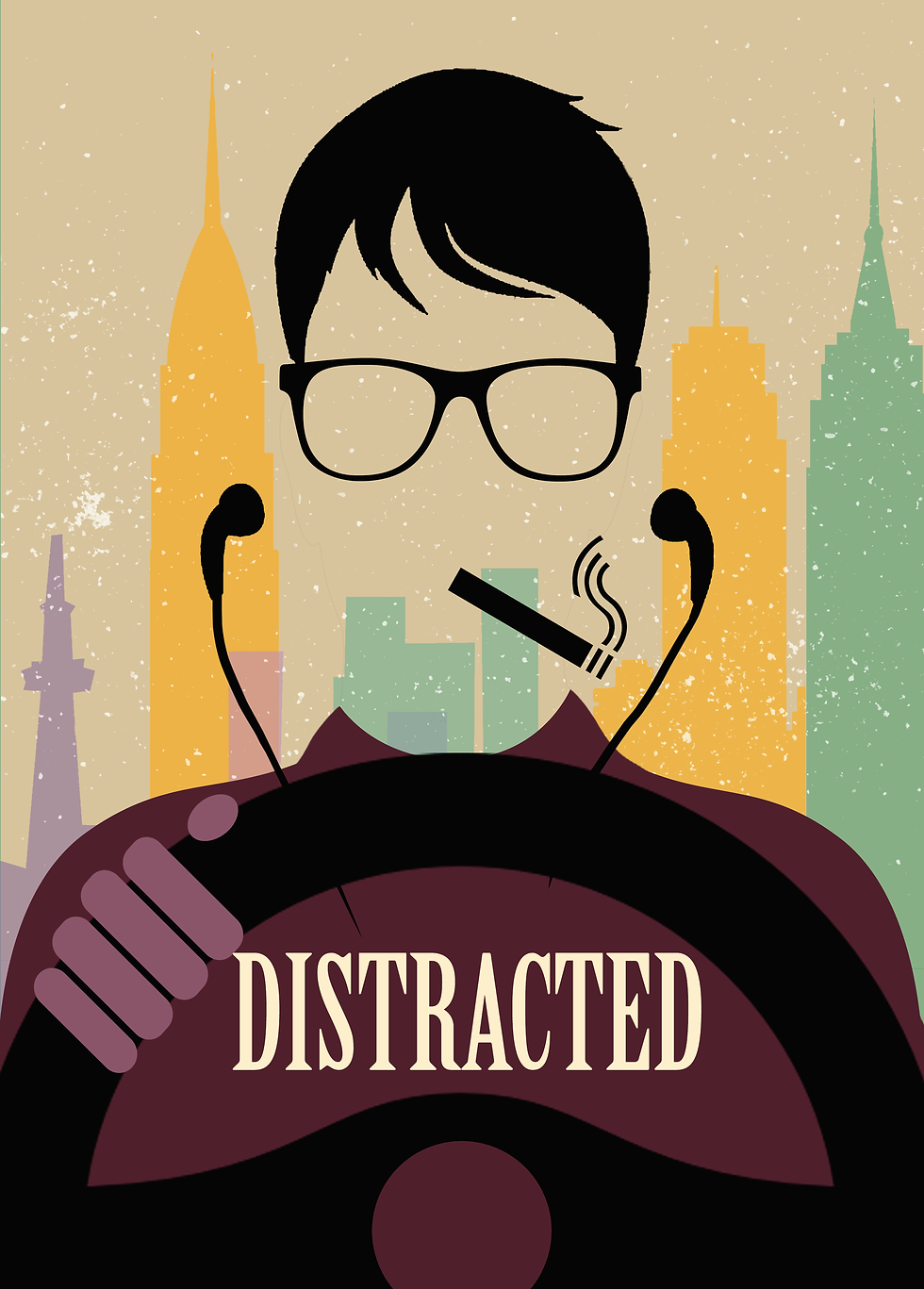
DISTRACTED DRIVING
These designs were based on Bandura’s Social Learning Theory (SLT). SLT has a history of being used in health-related advertising campaigns. The SLT involves a perceived susceptibility to a threat and its severity; the perceived benefits and costs/drawbacks of performing the recommended action; whether there is a cue to action; and whether the individual believes they are capable of carrying out the recommended response.
The campaign also used a twin poster design depicting a safe driver in contrast with a distracted driver. These posters were displayed around the university campus both in pairs and individually.